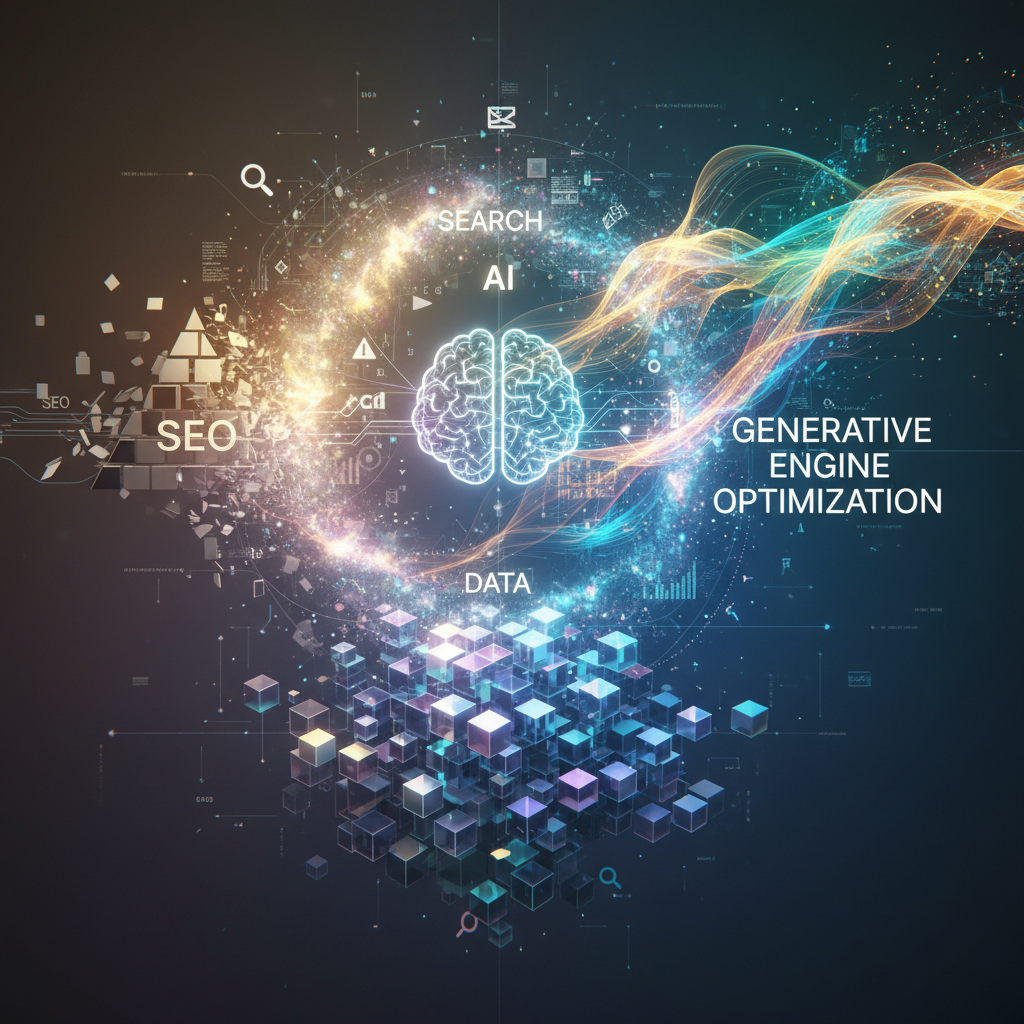
Generative Engine Optimization (GEO): The New Frontier for Performance Marketers
The rules of search are rewritten. Your SEO strategy, once a reliable engine for traffic, now faces obsolescence. Generative AI fundamentally reshapes how information is found, consumed, and credited. This isn’t an evolution, it’s a revolution. Adapt, or get left behind.
SEO Is Dead. Long Live GEO.
For decades, SEO focused on algorithms. We chased keywords, built links, and optimized for traditional ranking signals. The goal: position content high on the Search Engine Results Page (SERP). Success meant clicks. Generative AI changes the game entirely. Users now expect direct answers, synthesized from multiple sources, presented instantly. The “ten blue links” model is dying. Direct answers, generated by AI, are the new battleground for visibility.
The Core Divide: SEO vs. GEO
Traditional SEO: Ranking on SERPs
- Targeted specific keywords.
- Prioritized link profiles and domain authority.
- Focused on technical site health, crawlability, indexability.
- Measured success by SERP position and organic click-through rate.
Generative Engine Optimization: Direct Answers, Direct Impact
- Optimizes for AI consumption, not just crawling.
- Aims for direct citation and summarization by AI models.
- Prioritizes semantic clarity, factual accuracy, and comprehensive answers.
- Measures success by AI citation, brand mentions in generative results, and direct answer visibility.
The shift is profound. SEO sought to influence an algorithm. GEO seeks to educate an intelligence.
Why Your Content Needs a Generative Overhaul
AI-powered search engines, like Google’s SGE or ChatGPT-powered experiences, are designed to keep users within the generative interface. This means fewer clicks to your site. Your content needs to be the source that AI chooses to cite. It needs to be the definitive answer. If an AI summarizes a topic, and your brand isn’t credited, you lose. You lose visibility, authority, and ultimately, market share.
Actionable Strategies for Generative Engine Optimization
Clarity and Conciseness are King
AI models digest information. They do not appreciate ambiguity. Present facts, definitions, and processes with surgical precision. Use short, declarative sentences. Eliminate fluff. Every word must earn its keep.
Contextual Relevance, Not Just Keywords
Keywords remain relevant, but only as guides. AI understands context. It understands intent. Craft content that fully answers a user’s implied question, not just their typed query. Provide complete, self-contained answers within sections. Structure content logically. Make it easy for AI to extract definitive information.
Structured Data: The AI’s Blueprint
Schema markup is no longer optional, it is fundamental. Use structured data to explicitly define entities, facts, relationships, and processes within your content. This provides AI with a clear, unambiguous map of your information. Make your data machine-readable.
Build Citation-Worthy Content
Become the expert. Produce original research, proprietary data, and unique insights. AI prioritizes authoritative sources. Your content must be the go-to reference. Demonstrate expertise, experience, authority, and trustworthiness (EEAT) with every piece. AI is built on credible information.
Track What Matters: New Metrics for a New Era
Traditional metrics still hold some value, but new ones emerge. Monitor direct citations by AI models. Track brand mentions in generative summaries. Measure the visibility of your content in direct answer boxes. Understand how often AI chooses your site as a source. If you cannot measure it, you cannot manage it.
Challenges and Risks: Don’t Go All In Blindly
Over-optimization for AI carries risks. An AI-first approach might alienate human readers. AI models constantly evolve, requiring continuous adaptation. Dependence on a single AI platform creates vulnerability. Maintain a balanced strategy. Human readability and user experience still matter.
Bottom Line
Generative Engine Optimization is not a trend, it is the future of search. Performance marketers must adapt now. Focus on mathematical precision, content efficiency, and measurable citations. Integrate GEO into your overall business strategy. This secures long-term growth and positions your brand as an indispensable, cited authority in the age of AI. Failure to adapt is not an option. Your ROI demands this shift.